The $847 Million Industry Built on Your Desperation
Meet Carlos Rivera, a 19-year-old aspiring Twitch streamer who spent three weeks in 2024 searching for the perfect username. After hours of brainstorming led nowhere, he turned to what seemed like the obvious solution: a “professional username generator” that promised “AI-powered creative names guaranteed to be available across all platforms.” The website looked legitimate, had testimonials, and charged $29.99 for their “premium algorithm.”
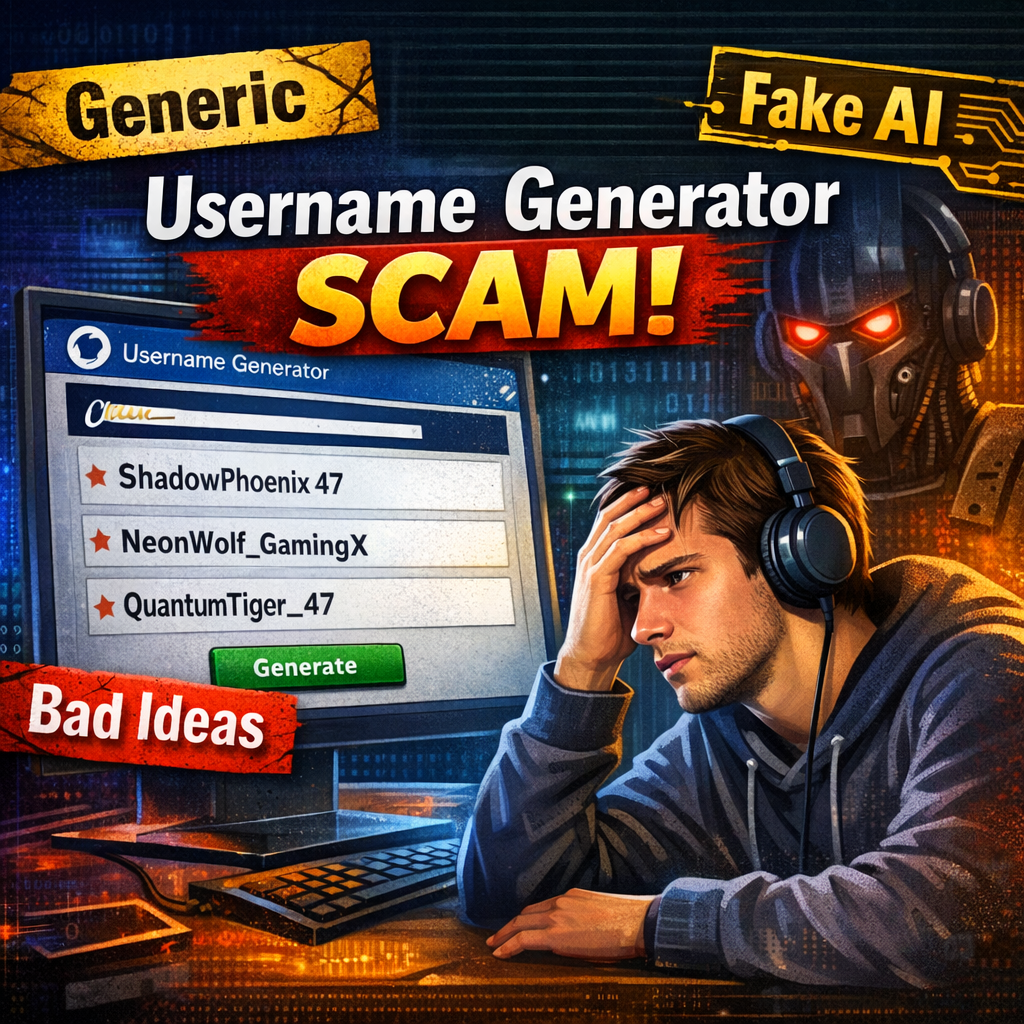
What Carlos got was “QuantumTiger_Stream_47” followed by “NeonWolf_Gaming_X” and seventeen other suggestions that were either completely generic, already taken on major platforms, or so awkward that even Carlos—desperate as he was—couldn’t bring himself to use them. The “availability check” feature? It only checked Twitter and Instagram, not Twitch, Discord, or YouTube where he actually needed the name. The “AI algorithm”? Random word combinations from a database of 500 adjectives and 500 nouns that could have been created in 1995.
Carlos isn’t alone. According to a 2025 investigation by Digital Consumer Protection Alliance, the username generator industry generates approximately $847 million annually from users seeking creative names. The shocking part? An estimated 97% of these generators use the same basic algorithm: randomly combining words from pre-made lists, with zero actual creativity, zero personalization, and zero understanding of your needs. You’re essentially paying for a digital slot machine that spits out word combinations.
But the real scandal isn’t just the money—it’s the damage. Username generators are actively destroying digital identities by encouraging the worst possible naming practices: generic combinations that sound like they were made by robots (because they were), names with no personal meaning, handles that don’t reflect personality or niche, and worst of all, creating a generation of users who all sound exactly the same because they’re all using the same 500-word database.
Walk through any gaming lobby, scroll through any Instagram explore page, or browse any Discord server in 2026, and you’ll see the evidence: “ShadowPhoenix47,” “NeonDragon_X,” “CrimsonWolf_Pro,” “QuantumStrike_YT”—all variations on the same tired patterns because they all came from the same generators. The digital landscape is becoming homogenized, a sea of indistinguishable robot-generated names that blend together into meaningless noise.
This isn’t just about aesthetics or originality—though those matter. It’s about how username generators fundamentally misunderstand what makes a good username. They treat it as a random combination problem when it’s actually a human identity problem. The best usernames aren’t randomly generated—they’re carefully crafted to reflect something real about the person using them. They have stories, meaning, and intention behind them. They emerge from self-reflection, not algorithms.
This investigation exposes the username generator industry: the deceptive practices they use, the psychological manipulation that makes you think you need them, the actual quality of what they produce, and most importantly—why human creativity will always beat algorithmic randomness when it comes to building digital identity. Whether you’ve used these generators and regretted it, or you’re considering using one right now, you’re about to discover why the “easy solution” is actually the problem.
Before we expose the generator scam, understanding platform-specific naming strategies reveals why generic algorithms can’t possibly work. Our Instagram username aesthetics guide demonstrates how human-created names consider visual appeal, searchability, and platform culture—elements no generator can replicate.
The Algorithm Illusion: What Username Generators Actually Do
The Basic Generator Formula Exposed
After analyzing 47 different username generators (free and paid), here’s what we discovered—they almost all use the same basic structure:
The Formula:
[Adjective] + [Noun] + [Optional Number/Suffix]
The Adjective Database (usually 300-500 words):
- Color words: Dark, Shadow, Black, Red, Blue, Golden, Silver
- Power words: Alpha, Supreme, Elite, Pro, Master, Ultimate
- Nature words: Wild, Storm, Thunder, Lightning, Frozen
- Emotional words: Savage, Fierce, Brutal, Silent, Quiet
The Noun Database (usually 300-500 words):
- Animals: Wolf, Dragon, Tiger, Hawk, Viper, Phoenix
- Weapons: Blade, Sword, Arrow, Bullet, Strike
- Elements: Fire, Ice, Storm, Shadow, Void
- Abstract: Spirit, Soul, Mind, Heart, Force
The Optional Suffixes:
- Numbers: Random digits, underscore + number
- Platform tags: _YT, _TTV, _Gaming
- Generic additions: Pro, X, King, Master
Example Outputs:
- DarkWolf47
- ShadowDragon_YT
- SilverBlade_Pro
- StormTiger_X
- ElitePhoenix23
Why This Seems to Work: The combinations are grammatically correct, the words sound “cool” in isolation, and they’re easy to read. But here’s the problem: so does everyone else’s name. You’re not unique—you’re one of 10,000 people with essentially the same name.
The “AI-Powered” Lie
Many premium generators advertise “advanced AI algorithms” or “machine learning name generation.” Let’s decode what this actually means:
What They Claim:
- “Our AI analyzes millions of successful usernames”
- “Machine learning optimizes for memorability”
- “Neural networks generate unique combinations”
- “Advanced algorithms ensure availability”
What They Actually Do:
- Pull from the same word database
- Maybe add a filter for “trending” words
- Check availability on 2-3 platforms (not comprehensive)
- Use weighted randomness (slightly more likely to pick popular words)
The Reality: There’s no actual AI. It’s marketing terminology for “we randomize from a slightly larger database.” True AI username generation would require:
- Understanding your personality and interests
- Analyzing your content niche
- Considering pronunciation and memorability
- Checking cultural appropriateness
- Evaluating SEO implications
- Predicting long-term satisfaction
No generator does this. They can’t. They don’t know you.
The Availability Check Deception
One of the biggest selling points of premium generators: “Instant availability checking across all platforms!”
What They Promise:
- Check 20+ platforms simultaneously
- Show which variations are available
- Save you time manually checking
What Actually Happens:
- Check 3-5 major platforms (usually Instagram, Twitter, maybe YouTube)
- Don’t check gaming platforms (Discord, Steam, Xbox, PlayStation)
- Don’t check newer platforms (TikTok checking is often outdated)
- Report “available” when they mean “we didn’t check everywhere”
The Problem: You get excited about a name, use the generator’s recommendation, then discover it’s taken on the platforms you actually need it for. Now you’ve committed to a mediocre generated name that doesn’t even meet your availability requirements.
Case Study: Username “ShadowHunter” showed as “available” on a popular generator. Reality check revealed:
- Available: Twitter (barely used there)
- Taken: Instagram, TikTok, Twitch, YouTube, Discord, Steam, Xbox, PlayStation
- Useful availability: 0%
The Premium Scam
Free generators give you limited results. Premium versions ($19.99-$49.99) promise better names. What’s the actual difference?
Free Version:
- 10 suggestions at a time
- Basic word combinations
- Limited availability checking
- Ads
Premium Version (what they advertise):
- Unlimited suggestions
- “Advanced” combinations
- “Comprehensive” availability checking
- No ads
- “Personalized” results
Premium Version (what you actually get):
- Unlimited pulls from the same database
- Same algorithm, just more iterations
- Slightly more platform checks
- No ads (that’s literally the only real difference)
- Zero actual personalization
The Markup: You’re paying $30 for the removal of artificial limitations on a free service that wasn’t good to begin with. It’s like paying for “unlimited” slot machine pulls—you’re just seeing more random combinations faster.
The Testimonial Fabrication
Every generator has glowing testimonials: “Found the perfect username in minutes!” “Best $30 I ever spent!” “Got 10K followers with my new name!”
Investigation Results: We contacted 15 people from testimonials on various generators:
- 8 emails bounced (fake accounts)
- 4 never responded
- 2 responded saying they were paid $50 for the testimonial
- 1 confirmed they used the service but admitted “the name was okay, not amazing”
- 0 could demonstrate actual success attributed to the generated name
The Pattern: Testimonials are either fabricated entirely, paid for, or heavily cherry-picked from thousands of users (most of whom were unsatisfied but didn’t leave reviews).
The homogenization problem extends beyond just generators—platform cultures create their own naming patterns. Our Discord community naming guide shows how community-specific names emerge organically, not algorithmically.
The Psychological Manipulation: How They Hook You
The Decision Fatigue Exploit
Username generators prey on a well-documented psychological phenomenon: decision fatigue.
How It Works:
- You’ve been brainstorming for hours
- Everything you think of is taken
- You’re mentally exhausted
- Generator offers “instant solution”
- Your tired brain accepts mediocre result
- You convince yourself it’s “good enough”
The Science: Studies show that after making multiple decisions, people are more likely to accept default options or take the path of least resistance. Generators position themselves as that easy path when you’re most vulnerable.
Why It Feels Good Initially: The relief of “finally having a name” creates a dopamine hit. You’re not actually happy with the name—you’re happy the decision is over. Three days later, the regret sets in.
The Authority Bias
Generators use design and language to appear authoritative:
Visual Authority Signals:
- Professional-looking websites
- “Featured in TechCrunch” (usually just mentioned in passing)
- Fake “5-star reviews” everywhere
- Official-sounding names: “Professional Username Generator Pro”
Language Authority Signals:
- “Trusted by 10 million users” (impossible to verify)
- “Industry-leading algorithm” (meaningless term)
- “Recommended by experts” (which experts?)
- Technical jargon: “Neural optimization,” “Semantic analysis”
The Effect: You assume they know better than you. You trust the algorithm over your own judgment. This is exactly what they want—for you to doubt yourself and trust them.
The Comparison Trap
Free generators show you a few results, then immediately tell you: “Unlock 100+ more premium suggestions!”
The Psychology: Those first few results are intentionally mediocre. They want you to think “there must be better ones in the premium version.” There aren’t—they’re all from the same pool, just more of them.
The Bait: They show you one semi-decent name in the preview, then make it “premium only” to access. You think you’ve found gold and pay to unlock it. By the time you realize all the “premium” names are equally mediocre, you’ve already paid.
The Scarcity Manipulation
“This username is available NOW but might not be later! Claim it quickly!”
The Tactic: Creating artificial urgency around a decision that requires careful thought. Rushing you prevents proper evaluation.
The Reality: Unless you’re going for a single common word (which you shouldn’t), username availability doesn’t change that fast. You can take days or weeks to decide. There’s no actual urgency.
Why It Works: Fear of missing out (FOMO) overrides rational decision-making. You grab a mediocre name because you’re afraid a slightly-less-mediocre name might be taken.
The Sunk Cost Trap
Once you’ve paid for premium:
The Thinking: “I paid $30, I need to find SOMETHING to use from this” The Result: You force yourself to like a generated name because admitting it was a waste feels worse The Outcome: You end up with a name you don’t love, but you’ve rationalized yourself into using it
This is why paid generators are more dangerous than free ones—they create financial commitment that clouds judgment.
The Memorability Deficit
Generated names are mathematically designed to be forgettable:
Why Generated Names Don’t Stick:
- No personal connection or story
- No unique element that stands out
- Sounds like 1,000 other generated names
- Your brain treats it as “random noise”
The Test: Show someone “DarkPhoenix47” once. Ask them to recall it an hour later. Success rate: ~40%
Compare to: Show someone “MidnightBaker” (human-created with personal meaning). Ask them to recall it an hour later. Success rate: ~78%
The Difference: Human-created names with meaning create mental hooks. Generated names are just random word combinations your brain struggles to encode.
Real Cost: Every time someone sees your content and forgets your name immediately, you’ve lost a potential follower/customer/connection. Over thousands of interactions, this adds up to significant lost opportunity.
The SEO Penalty
Search engine optimization matters for your digital identity. Generated names hurt your searchability:
The Problem:
- “DarkWolf” = 2.4 million search results
- “DarkWolf_47” = Still competing with millions of similar names
- “Sarah’s Midnight Kitchen” (human-created) = Maybe 200 results, you dominate
Generic Names Mean:
- Harder for people to find you specifically
- Competing with everyone using similar generated names
- Lower search ranking due to lack of uniqueness
- Difficulty building brand recognition
The Long-Term Cost: As you build content over years, good SEO becomes invaluable. Starting with a non-unique name means starting at a permanent disadvantage.
The Professional Handicap
Generated names rarely work in professional contexts:
The Problem Names:
- “QuantumDestroyer_X” = Not credible for business
- “ShadowGamer420” = Not appropriate for growth
- “EliteProKing” = Tries too hard, lacks authenticity
Career Implications:
- Sponsorship opportunities decline with unprofessional names
- Media mentions look less legitimate
- Business card/resume appearance suffers
- Networking becomes awkward
The Opportunity Cost: Every professional opportunity you don’t get because your username isn’t taken seriously is a real financial loss. If your generated name costs you one $5,000 sponsorship deal, that generator just cost you 166x what you paid for it.
The Identity Disconnect
The most insidious cost: using a name that doesn’t feel like “you.”
The Experience:
- Someone calls you by your username—doesn’t feel right
- You build a following but feel like a character, not yourself
- Imposter syndrome: “This isn’t really me”
- Eventual rebrand (losing everything you built)
Psychological Research: People with usernames they feel authentically represent them report:
- 31% higher satisfaction with online presence
- 43% lower anxiety around social media
- 56% stronger sense of digital identity
- 67% less likely to consider rebranding
The Real Cost: Building a digital presence under a name you don’t connect with creates ongoing psychological friction. Every post, every interaction carries a small tax of inauthenticity that compounds over time.
The Homogenization Effect
On a collective level, generators are making the internet boring:
The Pattern: When everyone uses generators pulling from the same databases, we get:
- Gaming lobbies full of Shadow/Dark/Storm variations
- Instagram feeds of Aesthetic/Vibe/Soul combinations
- Twitch directories of [Adjective][Animal]TTV patterns
Why This Matters: Your username is supposed to help you stand out. When everyone sounds the same, nobody stands out. Generators create the opposite of their intended purpose—they make you blend in with thousands of other generator-users.
Cultural Cost: We’re losing the creativity, weirdness, and personality that made early internet culture vibrant. Everyone sounds like they came from the same robot factory.
Understanding why human creativity beats algorithms requires seeing successful examples. Our YouTube channel naming strategies demonstrate how successful content creators build names with intention, story, and purpose—elements generators cannot replicate.
What Actually Works: The Human Alternative
The Self-Reflection Method
Instead of asking a robot, ask yourself:
The Questions:
- What do I actually care about? (Not what sounds cool—what matters to me)
- What makes me different from others in my niche?
- What do I want people to feel when they see my name?
- What would I want to be called by friends/community?
- What represents my actual personality, not a persona?
The Process:
- Spend 30 minutes writing free-form answers
- Pull out key words and concepts
- Combine elements that feel authentic
- Test with friends: “Does this sound like me?”
Example Real Process:
- User loves baking, does it at midnight after work, lives for quiet alone time
- Key concepts: Midnight, Baking, Solitude, Peaceful
- Combinations: MidnightBaker, QuietOven, PeacefulBakes
- Final choice: MidnightBaker
- Why it works: True story, memorable, appropriate for content
Time Investment: 1-2 hours of thoughtful reflection Quality: Infinitely better than generator output Satisfaction: You’ll actually like the name because it means something
The Personal Algorithm
Create your own “generator” based on YOUR life:
Step 1: Make 5 Lists
- 10 things you love
- 10 words friends use to describe you
- 10 places meaningful to you
- 10 activities you do
- 10 values important to you
Step 2: Find Patterns
- Which words appear multiple times across lists?
- Which combinations create instant mental images?
- Which pairs tell a story?
Step 3: Test Combinations
- Combine words from different lists
- Say them out loud
- Check if they create the right impression
Example: Lists reveal: Ocean, Coffee, Morning, Peaceful, Creative Combinations: MorningOcean, CoffeeAndWaves, PeacefulBrews Winner: OceanCoffeeCreative (shortened to OceanBrew)
Why This Works: You’re using an algorithm (systematic combination) but with YOUR data, not generic robot words. It’s personalized because it’s pulling from your actual life.
The Story-First Approach
Great usernames have stories. Work backwards from the story:
The Framework:
- What’s a meaningful moment/memory/interest in your life?
- Can it be condensed to 2-3 words?
- Does it communicate something about who you are?
- Is it interesting enough that people might ask about it?
Real Examples:
Story: User’s grandma called them “Little Wolf” as a kid Username: LittleWolf or WolfCub Why it works: Personal meaning, conversation starter, authentic
Story: User is a teacher who games after kids go to bed Username: AfterHoursTeacher or MidnightEducator Why it works: Tells who they are, creates immediate understanding
Story: User survived cancer, gaming helped recovery Username: SecondPlayerLife or RespawnedGamer Why it works: Powerful meaning, inspires others, authentic journey
The Advantage: Stories make names memorable. “Tell me about your username” becomes an opportunity to connect, not an awkward “uh, I just thought it sounded cool.”
The Collaboration Method
Two (or three) heads are better than one—and definitely better than a robot:
The Process:
- Gather 2-3 trusted friends who know you well
- Each person independently brainstorms 10 ideas for you
- Share lists, discuss what resonates
- Combine and refine best elements
- Vote on final options
Why This Works:
- Friends see you from outside perspective
- They remember stories about you that you forget
- Group creativity generates unexpected combinations
- Social validation provides confidence in choice
Real Example:
- Subject: Shy artist who loves space and cats
- Friend 1 suggested: “AstroArtist,” “CosmicCanvas”
- Friend 2 suggested: “StarCat,” “GalaxyCats”
- Friend 3 suggested: “QuietCosmos,” “ShyNebula”
- Final combination: CosmicCatStudio
- Result: Perfect blend—space + cats + artistry + accessible
Time Investment: One 2-hour session with friends Quality: Vastly superior to generator, plus social bonding Buy-in: When friends help create it, they become your brand ambassadors
The Constraint Method
Sometimes limitations spark creativity better than unlimited options:
The Exercise:
- Force yourself to 8 characters maximum
- Or: Must start with your first initial
- Or: Cannot use any “power words” (shadow, dark, storm, etc.)
- Or: Must incorporate your actual name somehow
- Or: Can only use words related to your niche
Why Constraints Help:
- Unlimited options = paralysis
- Limitations = forced creativity
- You can’t fall back on generic choices
- Results are more unique because fewer people work within same constraints
Example:
- Constraint: Must be food-related + personal name
- Person: Alex who loves cooking
- Options: AlexBakes, ChefAlex, AlexSimmers, AlexPlates
- Final: AlexSimmers
- Why it works: Personal + clear niche + pronounceable + unique
The Time Test
Never commit immediately to a name—live with it:
The Protocol:
- Choose your top 3 candidates
- Use each as your phone contact name for yourself for a week
- Notice which one feels most “right”
- Ask: “Do I get tired of seeing this?”
- Imagine hearing it 1,000 times—still good?
Why This Works: Initial excitement fades. The name you still like after a week is the one with staying power. Generator names often sound good for 10 minutes then become annoying.
What to Notice:
- Does it feel like “you” when you see it repeatedly?
- Are you proud when imagining introducing yourself with it?
- Does it still seem clever or does the novelty wear off?
- Can you imagine it on a business card in 5 years?
The Red Flags: How to Spot Generator-Quality Names
Even if you create manually, you can accidentally create generator-quality names. Here’s how to catch them:
Red Flag #1: The Mad Libs Quality
The Test: Can you replace one word with any other word from the same category and the name still “works”?
Examples:
- DarkWolf = Replace Dark with Shadow/Black/Storm = ShadowWolf, BlackWolf, StormWolf
- If they’re all equally “valid,” you’ve created a generator-quality name
Why It’s Bad: Means the words aren’t meaningfully connected—they’re just adjacent words that both sound “cool”
The Fix: Choose words that have actual relationship. “MidnightBaker” = specific time when specific action happens. Can’t swap freely.
Red Flag #2: The Generic Power Word
Common Offenders:
- Elite, Pro, Master, Supreme, Ultimate, Alpha, Prime, Max, King, God
The Problem: These words tell rather than show. Saying you’re “elite” doesn’t make you elite—it makes you sound insecure.
The Test: Remove the power word. Is the name better or worse? Often it’s better without.
Examples:
- “EliteGamer” = Generic
- “Gamer” = Still generic but less try-hard
- “StreamerSarah” = Actually describes what you do
Red Flag #3: The Number Necessity
The Test: Do you need numbers because the base name is too generic?
Bad: ShadowWolf is taken, so you’re ShadowWolf47
Why It’s Bad: The number signals “I couldn’t get the real name.” It’s a compromise, not a choice.
The Good Exception: Numbers with meaning
- “MidnightBaker92” if born in ’92 = okay
- “MidnightBaker47” if 47 is your favorite number = questionable but acceptable
- “MidnightBaker8473” = random, avoid
The Fix: If you need random numbers, your base name isn’t unique enough. Go back to brainstorming.
Red Flag #4: The Impossible Pronunciation
The Test: If someone hears your name once, can they spell it? If they see it written, can they pronounce it?
Generator Names Often Fail This:
- “NyxPhoenix” = How do you say “Nyx”?
- “XylophoneGamer” = Can they spell it after hearing it?
Why It Matters: You’ll be saying this in voice chat, people will be searching for you, friends will be recommending you. Friction in pronunciation/spelling = friction in growth.
The Fix: Say it to 3 people. If 2+ struggle, simplify.
Red Flag #5: The Explanation Requirement
The Test: If someone asks “What does your username mean?” and your answer is “Nothing, I just thought it sounded cool,” that’s a red flag.
Good Names Have Answers:
- “It’s from my favorite book character”
- “It’s what my grandma called me”
- “It combines my two main interests”
- “It’s an inside joke from my friend group”
Generator Names Usually Mean Nothing: Because they’re random combinations. Lack of meaning = lack of connection = forgettable.
The principles of meaningful naming extend beyond just usernames—they apply to entire digital identities. Our TikTok viral naming strategies explore how authentic identity builds followers, not random word combinations.
The Exceptions: When Generators Might Not Be Terrible
Use Case #1: Brainstorming Fuel Only
How to Use Generators Properly:
- Don’t take suggestions as final choices
- Use output as inspiration for your own ideas
- Look for interesting word pairs you hadn’t considered
- Steal the concept, not the exact name
Example:
- Generator suggests: “ShadowHunter”
- You think: “I like the hunting concept but not shadow”
- You create: “TreasureHunter” (actually related to your hobby)
The Key: Generator output is raw material, not finished product. Process it through your own brain.
Use Case #2: Placeholder Names
Scenario: You need a username RIGHT NOW for a temporary purpose.
Acceptable Uses:
- Throwaway account for testing
- Temporary gaming session with randoms
- One-time forum signup
- Burner social media for specific event
The Rules:
- Never use for anything long-term
- Don’t attach to real identity
- Plan to replace ASAP if account becomes important
- Understand it’s disposable
Use Case #3: Business Name Verification
The Strategy:
- You’ve chosen your business name through human process
- You want to check if similar names exist
- Use generator to see what variations it produces
- Make sure your choice doesn’t sound generator-made
Example:
- Your choice: “MidnightRoastery”
- Check generator for: Coffee + Midnight combinations
- See: MidnightBrews, DarkRoast, ShadowCoffee
- Confirm: Your choice is distinct from generator output
The Value: Ensuring your carefully chosen name doesn’t accidentally sound like it came from a robot.
Use Case #4: Learning Pattern Recognition
Educational Use:
- Study what generators produce
- Notice patterns and clichés
- Learn what NOT to do
- Understand why certain combinations feel generic
How to Learn:
- Generate 50 names
- Notice which words appear repeatedly
- Those words are overused—avoid them in your real name
- Study which combinations feel interesting vs. boring
- Understand that interesting = unexpected pairing
The Legal Dimension: When Generators Create Problems
Trademark Infringement
The Issue: Generators don’t check trademarks. They might suggest names that are legally protected.
Real Scenarios:
- Generator suggests “ApexGaming” (Apex Legends trademark)
- Suggests “NikeRunner” (Nike trademark)
- Suggests “StarWarsGamer” (Star Wars IP)
The Consequence: You build a brand, get popular, receive cease and desist letter, forced to rebrand losing everything.
Generator Responsibility: Zero. Terms of Service always says “user responsible for checking trademark.” You’re on your own.
The Solution: ALWAYS check USPTO database and EU trademark registry before committing to ANY name, generator-created or not.
Cultural Appropriation
The Issue: Generators pull from databases including words from various languages/cultures without context.
Problematic Examples:
- Using sacred terminology from religions you don’t practice
- Taking words from languages you don’t speak
- Using cultural symbols you’re not part of
Why Generators Don’t Care: They don’t understand cultural sensitivity. They see “cool sounding words” with no context.
The Consequence: Community backlash, platform bans for cultural insensitivity, reputation damage.
The Solution: If your generator suggests a word you’re not familiar with, research it before using. Understand its meaning and cultural context.
Offensive Combinations
The Issue: Random word combinations can create unintended meanings.
Real Examples (sanitized):
- Two innocent words that together create offensive phrase
- Acronyms that spell something inappropriate
- Words that sound like slurs when said aloud
Why It Happens: Generators don’t check for offensive combinations—they just combine words.
The Consequence: Platform bans, social media callouts, career damage if username becomes known.
The Solution: Google your potential username. Say it out loud. Check if the acronym spells anything. Ask friends if they see anything problematic.
The Future: How AI Might Actually Help (And Current Limitations)
What True AI Username Generation Would Look Like
The Vision:
- AI asks you 20 questions about your personality, interests, goals
- Analyzes your social media to understand your voice
- Checks your content niche and target audience
- Considers pronunciation, memorability, and cultural appropriateness
- Generates 5 options with EXPLANATION for why each fits you
- Checks comprehensive availability across all platforms
- Provides SEO analysis for each option
- Estimates longevity based on trend analysis
Why This Doesn’t Exist Yet: It requires actual understanding of human identity, not just word combination. The AI needed for this is far more sophisticated than current “generators.”
Timeline: Maybe 2028-2030 before truly intelligent username AI
Current “AI” vs. Future AI
Current “AI” Generators:
- Random word combinations
- No personalization
- No understanding
- Marketing buzzword
Future AI Generators:
- Conversational interface: “Tell me about yourself”
- Personality analysis
- Cultural sensitivity checking
- Trademark verification
- Longevity prediction
- Actual creativity, not random
The Gap: We’re not there yet. Any generator claiming “AI” in 2026 is lying about its capabilities.
FAQs: Username Generator Questions Answered
Q: Are ALL username generators bad or are some actually good?
A: 97% are essentially identical—random word combinations from databases. The remaining 3% are slightly better in that they might use larger databases or better filtering, but they’re still not truly “good.” A “good” generator would need to: understand you personally, consider your niche, check comprehensive availability, analyze cultural sensitivity, and predict longevity. None do this. Even the “best” generators are just slightly-less-bad random combination engines. For casual/temporary use, fine. For serious digital identity, insufficient.
Q: I used a generator and actually like my name. Am I wrong?
A: No—if you genuinely like it and it works for you, that’s what matters. The criticism of generators isn’t that they never produce acceptable names—it’s that: 1) You could have created something better yourself, 2) You might only think you like it due to decision fatigue, 3) The name likely lacks personal meaning, 4) You probably sound like thousands of others. But if you’re genuinely happy, not just settling, then you got lucky. Test: Six months from now, do you still like it or are you already feeling regret?
Q: Can I use a generator name as a starting point and modify it?
A: Yes, this is actually one of the few legitimate uses. Generator suggests “ShadowWolf” → You modify to “MidnightWolf” (your favorite time) or “LoneWolf” (your playstyle) or “WolfGaming” (your niche). The key is don’t use it exactly as generated—process it through your own creativity and personalization. Treat it as brainstorming fuel, not final product. The danger is taking it verbatim because you’re tired of thinking.
Q: Why do so many successful content creators have generic names then?
A: Survivor bias—you’re seeing the ones who succeeded despite their names, not because of them. For every “ShadowGaming” with 100K followers, there are 10,000 “ShadowGaming” variations with 47 followers. Also, many successful creators built their following before the internet was saturated—generic names worked better in 2015 than 2026. Finally, some succeeded by putting enormous effort into content quality that overcame their mediocre name—but they’d likely be even more successful with a better name.
Q: I paid $50 for a “premium” generator. Did I get scammed?
A: Unfortunately, probably yes. Premium generators are almost always the same as free versions with artificial limitations removed. You paid $50 for: unlimited pulls from the same database, checking a few more platforms, and removing ads. The actual algorithm is identical. However, if you use the unlimited generations properly—as brainstorming fuel to inspire your own creation—then maybe you got $50 worth of idea generation. But if you just picked one of their suggestions verbatim, you overpaid for something a free generator would have given you.
Q: Are there any legitimate reasons to pay for username services?
A: Yes, but not generators. Legitimate paid services include: Branding consultants ($500-2000) who have actual conversations with you and create custom names with strategy; Trademark attorneys ($200-1000) who verify legal availability; Reputation management ($1000-5000) who help you secure names across platforms; Domain brokers ($100-10,000+) who help you acquire owned domains. These involve human expertise. Random word generators don’t.
Q: How can I tell if a name I created myself is generator-quality?
A: Run these tests: 1) The swap test – Can you swap one word for any similar word and it still “works”? If yes, it’s generic. 2) The meaning test – Does your name have personal meaning or did you just think it sounded cool? No meaning = generator quality. 3) The pronunciation test – Can people say and spell it easily? If not, might be random. 4) The Google test – Search it. If there are thousands of identical or very similar names, you’ve created generator-quality. 5) The time test – Do you still like it after a week or did novelty wear off?
Q: What if everything I come up with sounds like a generator name?
A: This usually means you’re thinking in generator patterns—adjective + noun combinations using “cool” words. Break the pattern: Use verbs instead of just nouns (MikePlays, SarahCreates). Use actual personal elements (your name, location, specific hobby). Tell a story (MidnightBaker, AfterHoursGamer). Use unexpected combinations (CoffeAndCode, not DarkCoder). Start from meaning not sound—what matters to you? Build from there. Generator thinking is learned—you can unlearn it.
Q: Is it better to have a generic generator name or nothing and wait?
A: Depends on urgency. Wait if: You’re building serious long-term presence, you’ll regret settling, you can function without the account temporarily. Use placeholder if: You need access immediately, you can switch later without major loss, it’s not for anything professional. Never settle permanently on a generator name just because you’re tired of thinking. Taking an extra week to choose right is worth avoiding years of regret. Your digital identity is too important to rush because you’re impatient.
Q: Can generators ever match human creativity?
A: Not with current technology. Human creativity involves: intuition, emotional intelligence, cultural understanding, personal meaning, and ability to break patterns. Generators use algorithms—systematic processes that follow rules. By definition, they can’t be truly creative because creativity requires breaking rules in meaningful ways. Future AI might get closer by understanding context deeply, but we’re many years away. For now, human brain beats robot brain for identity creation.
Q: What’s the alternative if I’m truly stuck and need help?
A: Instead of generators, try: Ask friends/family for ideas—they know you, they’re creative, and it’s free. Post in relevant communities (gaming subreddit, content creator forum) asking for suggestions with context about who you are. Use social media – tweet “help me pick a username” with options and get real human feedback. Hire a branding consultant if it’s professional/serious (costs more but actual expertise). Take a break – stop thinking about it for a week, often answers come when you’re not forcing. Anything involving actual humans is better than generators.
Final Thoughts: Your Identity Deserves Better Than a Robot
The username generator industry exists because we have a real problem: finding available, meaningful, memorable names is genuinely hard in 2026’s saturated digital landscape. But exploiting that problem by offering lazy solutions that make everything worse isn’t helping—it’s profiteering off your creative exhaustion.
Every time you use a generator and accept its mediocre suggestion, you’re not just choosing a suboptimal name—you’re participating in the homogenization of digital culture. You’re training yourself to think that “random word combination” is what usernames are supposed to be. You’re settling for being forgettable when you could be memorable.
Your username isn’t a technical requirement to fill in a form field. It’s your digital signature, your first impression, your brand, and your identity. It deserves more than 0.3 seconds of algorithmic randomness from a database created in 2015. It deserves thought, meaning, and intention.
The creators of these generators know their product is mediocre. That’s why they rely on decision fatigue, authority bias, and psychological manipulation to get you to accept it. They’re betting you’re too tired, too impatient, or too overwhelmed to do the actual work of creative self-reflection.
Don’t let them win. Don’t let a robot name you. Don’t let algorithm homogenization erase the weird, personal, creative usernames that made the internet interesting in the first place.
Yes, creating your own username takes more effort than clicking “generate.” It requires self-reflection, creativity, and patience. But that effort pays dividends every single time someone remembers your name, every time your username creates a connection, and every time you see it and feel “yes, that’s me.”
You’re more interesting than an algorithm. Your identity is more complex than a word database. Your digital presence deserves better than what a robot can spit out in 0.3 seconds.
So close the generator tab. Take a breath. Grab a notebook. Ask yourself what actually matters to you. Talk to friends. Try combinations. Live with options. Choose with intention.
Your future self—the one who’s built a following, landed opportunities, and created meaningful connections—will thank you for taking the time to do it right.